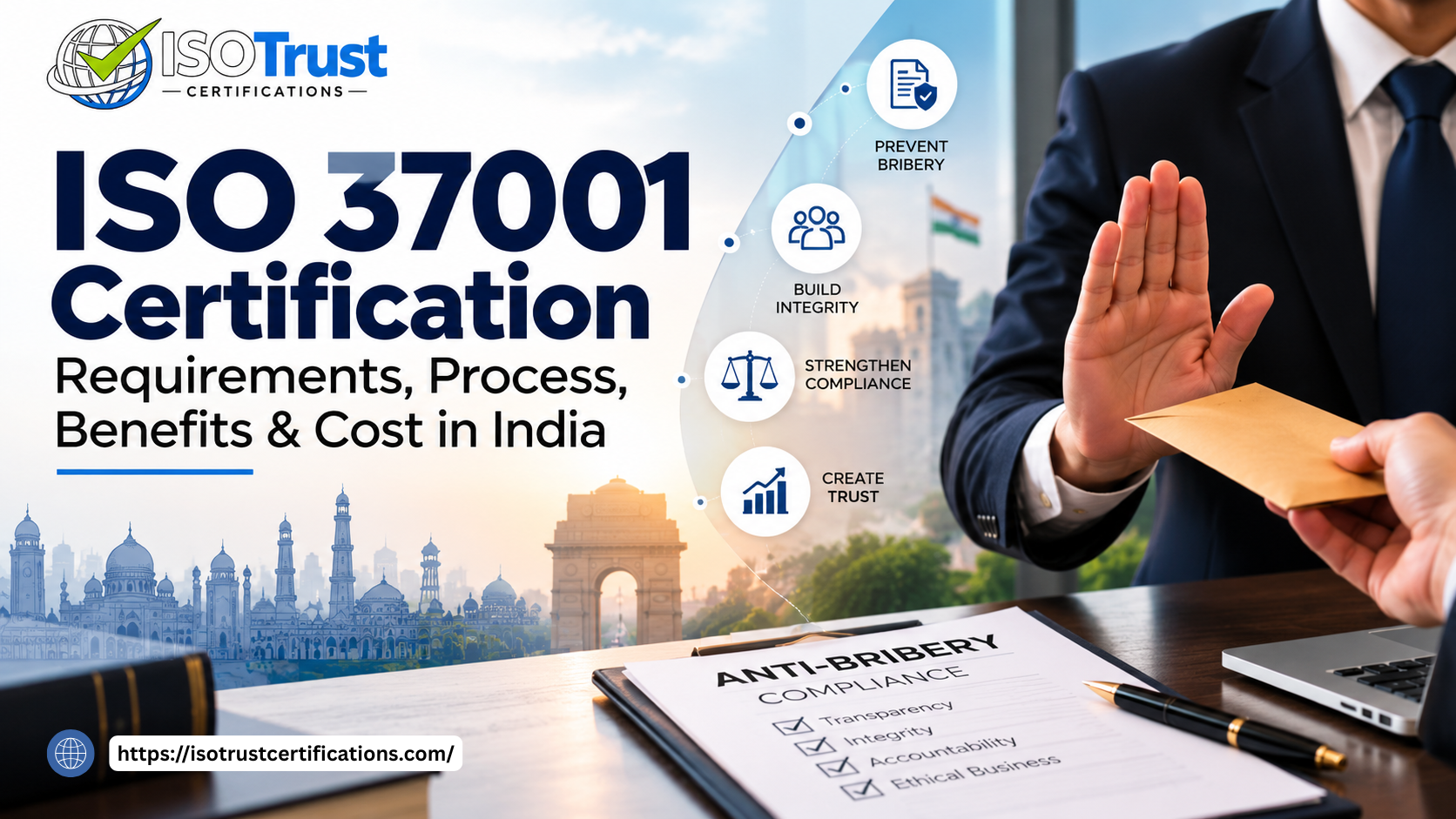
ISO 37001 Certification: Requirements, Process, Benefits & Cost in India
Bribery can cause serious issues related to finance, legal issues, and reputation for the business. Bribery can take place by means of employees, agents, vendors, contractors, or any third party. As companies expand their activities and collaborate with many third parties, setting up controls for bribery prevention and management becomes more significant.
ISO 37001 certification helps in doing so. ISO 37001 is an international standard for Anti-Bribery Management System (ABMS). It helps organizations to set up policies and controls to prevent bribery.
For businesses in India, getting certification will also indicate to their customers, partners, and other stakeholders that the company has set up an ABMS system.
What Is ISO 37001 Certification?
ISO 37001 is a management system standard aimed specifically at helping organizations to prevent, detect, and respond to bribes.
An ISO 37001 anti-bribery management system involves not only the development of an anti-bribery policy, but also other activities, such as bribery risk assessment, due diligence, employee training, financial controls, reporting, auditing, and review processes.
The standard can be used by organizations regardless of their size and type of activity. After implementing the system, an independent certification body can evaluate its compliance with the requirements of ISO 37001.
In case an organization meets all the required criteria, an ISO 37001 certificate is awarded to it for the specific scope of work.
Why Is ISO 37001 Certification Important?
There are a variety of areas where bribery can pose potential risk to a business including payments to agents, gifts and hospitality, purchasing, donations, commissions, and interaction with public officials.
ISO 37001 is useful to an organization in managing such risks using a systematic approach.
The standard may assist companies in ensuring that there are clear roles and responsibilities, conducting bribery risk assessment, improving internal control, offering employees’ awareness training, and procedures for dealing with complaints.
It may also assist in proving that the anti-bribery controls are a component of the management system of an organization.
This is more applicable to organizations which operate within government contracts, international customers, suppliers, agents, or other third parties.
Who Needs ISO 37001 Certification?
ISO 37001 is suitable for organizations across different industries. It can be implemented by both private and public-sector organizations, depending on their requirements and risk profile.
It may be relevant to:
- Manufacturing companies
- Construction businesses
- IT and software companies
- Engineering firms
- Healthcare organizations
- Consulting companies
- Import and export businesses
- Government contractors
- Financial and professional service providers
- Small and medium-sized enterprises
The standard is not limited to large organizations. A smaller company can also implement an ABMS, with the system designed according to its size, operations, locations, and bribery risks.
What Are the Requirements of ISO 37001?
The ISO 37001 certification requirements focus on establishing and maintaining an effective Anti-Bribery Management System.
Key areas include:
Anti-bribery policy: The organization should establish a clear policy explaining its commitment to preventing bribery.
Bribery risk assessment: The organization needs to identify and assess bribery risks associated with its activities, transactions, locations, and business relationships.
Leadership and responsibility: Management should demonstrate commitment to the ABMS and assign appropriate responsibilities.
Due diligence: Relevant employees, business associates, agents, suppliers, and other third parties may need to undergo due diligence based on the level of risk.
Financial and commercial controls: Appropriate controls should be established around payments, procurement, contracts, gifts, hospitality, donations, and other activities where bribery risks may arise.
Training and awareness: Employees should understand the organization’s anti-bribery policy, responsibilities, and reporting procedures.
Reporting and investigation: The organization should have suitable mechanisms for reporting concerns and procedures for handling suspected bribery.
Internal audit and management review: The ABMS should be regularly reviewed to determine whether it is working effectively.
Corrective action: Identified problems and nonconformities should be addressed, with appropriate action taken to improve the system.
What Is the ISO 37001 Certification Process?
The ISO 37001 certification process generally starts with understanding the standard and determining the organization’s certification scope.
A typical process includes:
1. Gap assessment: Existing policies, procedures, and controls are compared with ISO 37001 requirements to identify gaps.
2. ABMS development: The organization develops the policies, procedures, risk assessments, controls, and other processes required for its anti-bribery management system.
3. Implementation: The system is put into practice. Employees receive relevant information and training, while required controls and procedures are implemented.
4. Internal audit: An internal audit is conducted to identify weaknesses or nonconformities before the external certification audit.
5. Management review: Top management reviews the performance and effectiveness of the ABMS.
6. Certification audit: An independent certification body assesses the management system against ISO 37001 requirements.
7. Corrective action: If nonconformities are identified, the organization addresses them according to the certification body’s requirements.
8. Certification: After successful completion of the applicable certification requirements, the organization receives its ISO 37001 certificate.
The system must continue to be maintained and monitored after certification.
What Are the Benefits of ISO 37001 Certification?
An efficient implementation of the ABMS as per the ISO 37001 standard can allow for managing bribery risks in a more structured way.
Some possible advantages might be:
– better recognition of bribery risks
– more internal controls
– increased awareness among the employees
– better management of third parties.
A certificate would serve as proof of having put in place an Anti-Bribery Management System.
In cases where the operations of firms are in an environment of some tenders or in an environment with clients requiring proper anti-bribery controls, then certification of ISO 37001 can be useful.
Auditing, monitoring, management review, etc., would assist in the continuous improvement of anti-bribery controls.
How Much Does ISO 37001 Certification Cost in India?
The ISO 37001 certification cost varies from one organization to another. There is no single price that applies to every business.
The cost can depend on:
- Number of employees
- Number of locations
- Business activities
- Certification scope
- Operational complexity
- Bribery risk profile
- Existing management systems
- Audit duration
- Certification body
- Training and consultancy requirements
Implementation costs and certification-body fees may also be separate.
A small organization with one location may have different requirements from a large company operating across several locations. Therefore, an accurate quotation generally requires information about the organization’s size, activities, locations, and certification scope.
Frequently Asked Questions About ISO 37001 Certification
What is ISO 37001?
ISO 37001 is an international standard that provides requirements for an Anti-Bribery Management System.
How to get ISO 37001 certification?
An organization needs to establish and implement an ABMS, conduct internal audits and management reviews, address identified issues, and successfully complete an independent certification audit.
Is ISO 37001 certification mandatory in India?
ISO 37001 certification is generally voluntary. However, specific customers, contracts, tenders, or business relationships may have their own anti-bribery requirements.
How long does ISO 37001 certification take?
The timeframe depends on the organization’s size, scope, locations, existing controls, and level of preparedness.
Does ISO 37001 guarantee that bribery will never occur?
No. The standard provides a framework for identifying bribery risks, establishing controls, responding to concerns, and continually improving the management system.
Get ISO 37001 Certification With ISO Trust Certifications
ISOTrust Certifications can be of assistance for understanding the requirements necessary for the implementation and ISO 37001 certification process.
If your company needs to get ISO certification in Delhi, then you can contact ISO Trust Certifications regarding the activities of your company, its certification scope and requirements.
A well-structured ABMS helps the organization to detect bribery risks and controls them.

