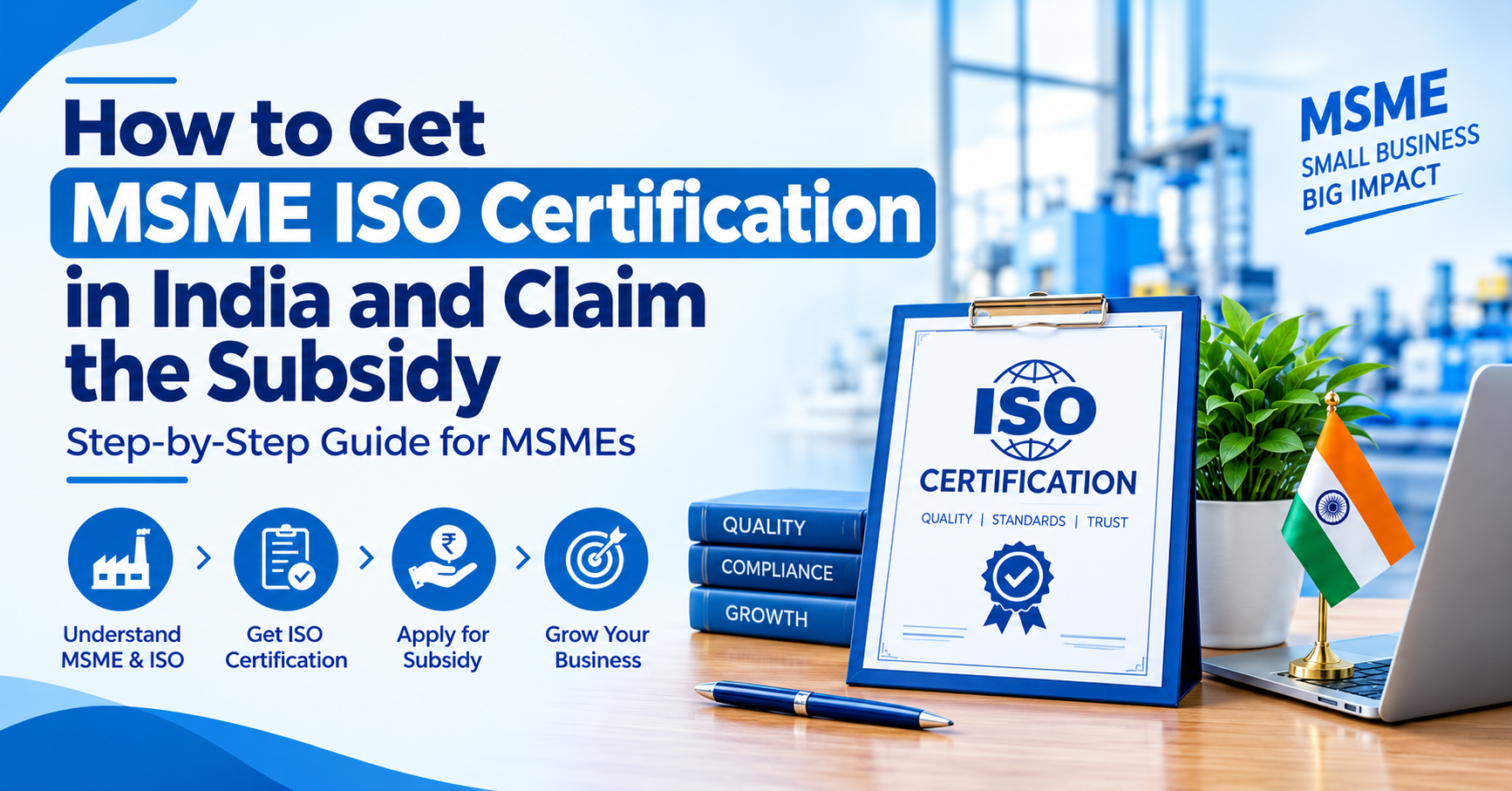
How to Get MSME ISO Certification in India
Quick answer
MSME ISO certification is an ISO certificate that a small business earns after an independent audit. It is separate from Udyam registration. Most MSMEs start with ISO 9001.
A customer requests your ISO certificate, you send them your Udyam certificate. Looks official and very different documents. Many small business owners are confused-they mix them up and lose orders.
This guide provides an easy to understand description of MSME ISO certification. You will know what it is and which standard to choose! Then, we discuss the process. It has been prepared by ISOTrust Certifications for the small business owners of India.
What does MSME ISO certification actually mean?
MSME ISO certification is a statement that an independent organisation has examined your small business’s operations. Not registered by the government.
By registering online for Udyam, you let the government know that your business is a micro, small or medium sized enterprise. By saying your processes are ISO certified, you are informing your buyers that your processes adhere to an international standard. The certificate is not issued by the government or ISO, but by a certification body.
Many owners look up for the term MSME ISO registration; however, it’s actually a term that means certification. There is no law that requires MSMEs. However, when you’re looking to place an offer for a tenders or large buyers, the certificate can make or break your chances of your offer being read.
| Udyam registration | ISO certification | |
|---|---|---|
| Who issues it | Government of India | Independent certification body |
| What it proves | Your business size and category | Your processes meet an ISO standard |
| Is it required | Voluntary, but linked to MSME schemes | Voluntary, but often asked by buyers |
Why is ISO certification for MSME worth getting?
The most common reason for ISO certification is to gain orders that require such evidence. A significant number of tenders require ISO 9001 as an eligibility criterion, and overall a bid that is not accompanied by an ISO 9001 could be disqualified at an early stage.
The same filter is used by the large buyers. Once they have narrowed down their selection of vendors, a certificate provides them with a quick rationale to say yes. Suppliers are requested by export customers and large manufacturers to provide the same proof.
The ISO 9001 advantages are also reflected within your business. Written procedures means no repeated mistakes. New staff learn work quicker, steps are on paper. Owners are not spending as much time on solving issues, but more time on growing the business.
Which ISO standard should an MSME start with?
The most recommended standard for an MSME to begin with is ISO 9001 for quality management. It is appropriate for manufacturers, traders and service businesses. The ISO 9001 certification for small business is equally applicable to a ten-man workshop and a large factory.
Other standards are suited to certain types of work. There are two other standards, ISO 14001 which addresses Environmental management and ISO 45001 which addresses Workplace health and safety. Both food businesses and IT companies might be interested in ISO 22000 and 27001, respectively, for food security and data security.
The easy to remember rule is the best. In either case the ISO accreditation MSME owners select must correspond to the one mentioned in the tender or buyer request. When no standard is specified, start with ISO 9001 and add others as your company expands. Growth should be the pace in each extra standard, audits, records and cost apply.
What is the ISO certification process for an MSME?
To obtain ISO 9001 certification or any other standard, a company undergoes six stages, the last of which is a two-stage audit.
- Choose the standard and identify which products, services, and sites must be certified.
- Conduct a gap analysis to identify differences between the current processes and the requirements of the standard.
- Develop standard operating procedures and assign responsibilities.
- Maintain required documentation, including training records, inspection reports, and customer feedback.
- Perform an internal audit and management review to address the identified gaps.
- Pass a certification audit, which consists of two stages: a documentation review and an on-site examination.
The required documents may vary depending on the certification body but typically include proof of registration and address of the company’s legal entity, a brief description of the organization’s activities, and others. A reliable provider will give a detailed list of the required documents. The time needed to prepare for an audit depends on the completeness of the documentation provided; therefore, it is advisable to request a detailed estimate from the certification body.
What should you do next?
When customers see that a business is MSME ISO certified, it provides them with a guarantee that they can rely on. The first thing you need to determine is the buyer’s standard. Then pick an accredited certification body before paying. ISOTrust Certifications helps you select the appropriate standard and get ready for the audit.
Frequently asked questions
Is ISO certification mandatory for MSMEs?
There is no legal mandate for MSMEs to get an ISO certificate. There are still a lot of tenders and big buyers who still require one before accepting a bid, or approving a vendor.
Is Udyam registration the same as ISO certification?
There are two documents: Udyam and ISO. Udyam is issued by the government as your MSME registration, ISO certification is given by an independent certification body after an inspection.
Which ISO certificate is best for a small business?
The common beginning to start is ISO 9001 which deals with quality management for all businesses. If you are only asked by your buyer, tender or industry to use a different standard then choose that one.
How much does ISO certification cost for a small business?
The cost depends on your business size, number of sites, chosen standard and certification body. Ask each provider for a written quote that lists audit fees and consulting fees separately.
How long is an ISO certificate valid?
An ISO certificate is usually valid for three years, with a surveillance audit each year in between. Renew before it expires, because tenders normally ask for a valid certificate.

